
If you’re in industries like chemicals, agriculture, construction, or food processing, you’ve likely used or specified Flexible Intermediate Bulk Containers (FIBCs) – more commonly known as jumbo bags or FIBC bulk bags. These workhorses of logistics are essential for storing and transporting dry, flowable products efficiently.
But have you ever wondered how these incredibly strong bags are actually made? Understanding the FIBC bags manufacturing process can help you make more informed purchasing decisions, ensuring you get the right bag for your specific needs, whether it’s safety, durability, or compliance.
At its core, manufacturing jumbo bags is a sophisticated process that blends advanced weaving technology, precise cutting, and rigorous quality control. Let’s walk through the key stages of how a jumbo bag is born.
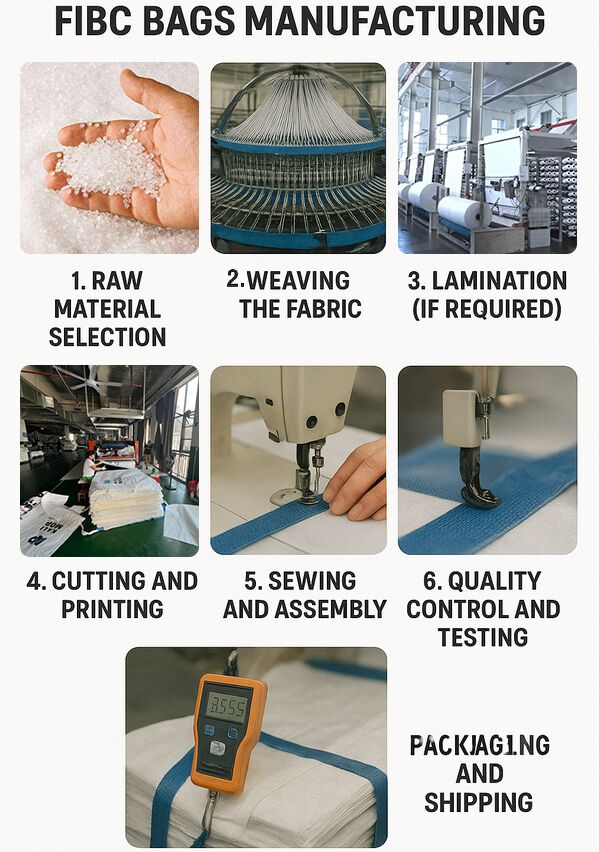
Stage 1: Raw Material Selection – The Foundation of Quality
It all starts with the primary raw material: polypropylene (PP). This thermoplastic polymer is chosen for its excellent strength-to-weight ratio, chemical resistance, and affordability.
- Virgin PP: Used for high-quality bags, especially those requiring food-grade or UV stabilization. It offers consistent strength and reliability.
- UV-Stabilized PP: Includes additives to protect the bag and its contents from degradation caused by sunlight during outdoor storage.
- Additives: Depending on the bag’s end-use, other additives like anti-static agents (for Type C or D bags) or slip agents can be mixed into the PP resin at this stage.
The PP resin is melted and extruded into thin, continuous tapes or filaments, which form the fundamental building blocks of the fabric.
Stage 2: Weaving the Fabric – Creating the Strength
The extruded PP tapes are then loaded onto large, circular looms. Here, they are woven into a robust, durable fabric known as circular woven polypropylene (CWPP).
- The loom interlaces the tapes in a tight, crosshatch pattern (warp and weft), creating a continuous tube of fabric.
- The denier (thickness) of the tapes and the weave density (number of tapes per square inch) are critically controlled. This determines the fabric’s ultimate strength, which is measured in N/m (Newtons per meter) or lbf/in (pounds-force per inch). Common ratings include 5:1 safety factor bags (e.g., 5:1 SF) or higher-performance 6:1 SF bags.
Stage 3: Lamination (If Required) – Adding Protection
For products that require protection from moisture or need to contain fine dust, a liner is essential. This is often achieved through lamination.
A layer of plastic film (like PP or LDPE) is thermally bonded to one side of the woven fabric. This creates a waterproof and dust-tight barrier, turning the fabric into a composite material ready for use in laminated jumbo bags.
Stage 4: Cutting and Printing – Precision and Branding
The large, continuous tube of woven fabric is then fed into a cutting machine. Using automated templates or CNC cutters, the fabric is precisely cut into the specific panels needed for the bag’s design:
- Body Tube: The main, cylindrical part of the bag.
- Lift Loops: The critical components that bear the entire load during lifting.
- Bottom and Top Panels: These are often reinforced for stability and filling/discharge.
Custom printing, such as company logos, handling instructions, or safety warnings, is typically done at this stage using flexographic printing.
Stage 5: Sewing and Assembly – Bringing It All Together
This is where the individual components are assembled into a finished bulk bag. Heavy-duty industrial sewing machines, using strong UV-resistant PP or polyester thread, stitch the pieces together.
Key steps include:
- Attaching the bottom panel to the body tube with strong, double-stitched seams.
- Sewing the lifting loops. This is a crucial step, as the loops must be correctly aligned and sewn with a specific stitch pattern to distribute the load evenly and ensure safety.
- Adding any special features, such as duffle tops (spout tops), cross-corner loops, or lining sleeves for inner liners.
Stage 6: Quality Control and Testing – Ensuring Safety and Reliability
A reputable manufacturer will never skip this step. Rigorous quality control is integrated throughout the entire process.
- Incoming Material Checks: Testing the tensile strength of the PP tapes and fabric.
- In-Process Checks: Monitoring sewing stitch quality and alignment.
- Final Product Testing: Random samples from each production batch are subjected to drop tests and lift tests. These tests simulate real-world conditions to ensure the bag can safely hold its stated Safe Working Load (SWL). For example, a bag might be filled to 2x or 3x its SWL and lifted to test its seams and loops.
Stage 7: Packaging and Shipping
The finished jumbo bags are compressed, folded, and bale-packed into compact units. This minimizes shipping volume and storage space, making transportation more cost-effective for both the manufacturer and the end-user. A standard bale can contain 100-200 bags, depending on their size.
Conclusion: More Than Just a Bag
The manufacturing of a jumbo bag is a precise, multi-stage engineering process. From the selection of raw polypropylene to the final strength testing, every detail matters. When you purchase an FIBC, you’re not just buying a simple bag; you’re investing in a highly engineered product designed to protect your valuable materials and ensure the safety of your workforce.
When sourcing your next order of bulk bags, choose a manufacturer that is transparent about their process and committed to stringent quality control. It’s the surest way to guarantee performance, safety, and value.