
🔍 If you’ve been searching for “UN certified bulk bags”, “UN rated bulk bags”, “what is UN approved packaging”, or “UN bulk bags” – you’re in the right place. At FIBC Bag Factory, we manufacture and supply UN certified FIBCs that meet the strictest international safety standards. This guide explains what UN certification means, how to read UN markings, and how to choose the right bag for your dangerous goods.
📖 Table of Contents
- • What Is UN Certified Packaging?
- • What Are UN Certified Bulk Bags (UN FIBCs)?
- • Why UN Certification Matters
- • UN Certification Testing Process
- • Understanding UN Markings on FIBCs
- • UN Certified vs Standard Bulk Bags
- • Types A, B, C, D – Which One Do You Need?
- • Industries & Applications
- • How to Verify Genuine UN Certification
- • Frequently Asked Questions
1️⃣ What Is UN Certified Packaging?
UN certified packaging refers to packaging that has been rigorously designed, tested, and certified to safely contain hazardous materials during transportation – by road, rail, sea, or air. It is governed by the UN Recommendations on the Transport of Dangerous Goods (Orange Book) and is legally required for any shipment containing dangerous goods.
A package bearing a UN mark proves that its design has passed performance tests for dropping, stacking, leakage, and vibration. This ensures safety for workers, carriers, and the environment.
2️⃣ What Are UN Certified Bulk Bags (UN FIBCs)?
UN certified bulk bags – also known as UN rated bulk bags, UN approved FIBCs – are heavy-duty flexible intermediate bulk containers that have passed UN performance tests specifically for dangerous goods.
- Safety factor: Minimum 6:1 (vs standard 5:1).
- Testing: Must be conducted by accredited third-party laboratories.
- Recertification: Required annually.
- Marking: Permanent UN code printed on the bag.
Commonly used for flammable powders, toxic chemicals, reactive substances, and environmentally hazardous solids.
3️⃣ Why Is UN Certification Mandatory?
⚠️ Did you know? A significant percentage of containers carrying dangerous goods show non-conformities (incorrect labels, insecure packaging). UN certified packaging eliminates most of these risks.
Without UN certified packaging, your shipment may be:
- Rejected at customs or ports
- Delayed indefinitely
- Subject to heavy fines
- Deemed illegal for international transport
UN certification protects your business from legal liabilities and ensures smooth cross-border logistics.
4️⃣ How UN Certification Works – 6 Critical Tests
Every UN certified FIBC design must pass the following tests at an accredited lab:
| Test | Description |
|---|---|
| Top Lift | Suspended with 6× SWL for 5 min – no permanent deformation. |
| Stacking | 24h top load – no leakage or damage. |
| Drop | Dropped from specific heights (31.5″ to 47.3″) – no rupture. |
| Topple | Bag toppled onto its top – must not burst. |
| Righting | Knocked on side and lifted upright – loops must remain intact. |
| Tear | 100mm cut at 45°, then loaded to 2× SWL – cut growth ≤25%. |
Plus a one-hour vibration test simulating transport conditions.
5️⃣ Reading UN Markings on Bulk Bags
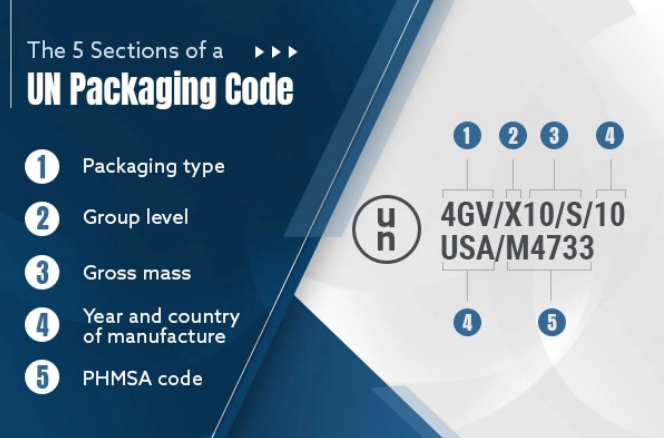
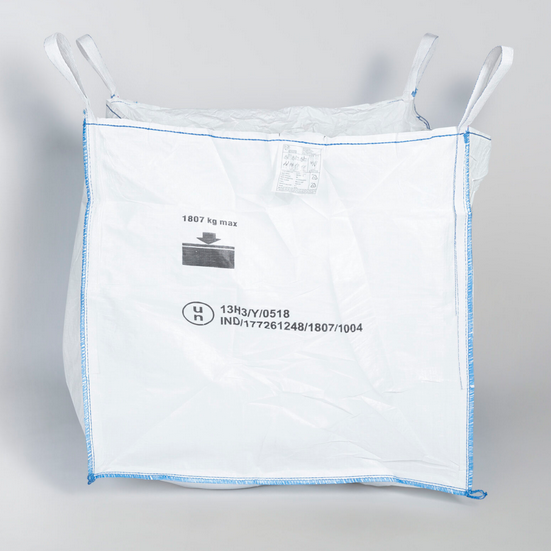
A typical UN marking looks like this: 13H3/Y/250/S/19/USA/ABC123. Here’s what each part means:
| Code part | Meaning |
|---|---|
| 13H3 | 13 = flexible container (FIBC), H = woven plastic, 3 = without structural equipment |
| Y | Packing group II & III (X=all groups, Y=II&III, Z=III only) |
| 250 | Max gross mass (kg) |
| S | For solids (or test pressure for liquids) |
| 19 | Year of manufacture (2019) |
| USA | Country of approval |
| ABC123 | Manufacturer & design code |
6️⃣ UN Certified vs Standard Bulk Bags
| Feature | UN Certified FIBC | Standard FIBC |
|---|---|---|
| Safety factor | ≥6:1 | 5:1 or 6:1 |
| Third-party testing | Required | Manufacturer only |
| Annual recertification | Yes | No |
| UN marking | Mandatory | None |
| Legal for dangerous goods | ✅ Yes | ❌ No |
7️⃣ FIBC Types A, B, C, D – Which UN Rated Bag Do You Need?
UN certified bags can be made in any of these electrostatic types. Choose based on your product and environment:
- Type A: No static protection – non-flammable materials only.
- Type B: Low breakdown voltage – for dry, combustible powders without flammable vapors.
- Type C: Conductive fabric – must be grounded for flammable/explosive atmospheres.
- Type D: Dissipative fabric – static neutralization without grounding.
8️⃣ Industries That Require UN Certified Bulk Bags
9️⃣ How to Verify Genuine UN Certification
- Check the UN mark on the bag – must be clear, durable, and correctly formatted.
- Request the test report and certificate from the manufacturer matching the code.
- Ensure tests were done by an accredited third-party lab (e.g., ISTA, SGS, Bureau Veritas).
- Ask for batch-specific documentation.
❓ Frequently Asked Questions
It means the bag design has passed UN performance tests (drop, stack, tear, etc.) by an accredited lab and bears a legal UN mark.
No difference – both terms are used interchangeably to describe packaging meeting UN dangerous goods regulations.
Yes. Any material classified as dangerous goods under UN regulations must use UN certified packaging.
The design certification is valid for one year. Annual recertification is required.
Possible, but must be inspected thoroughly. The certification status may not apply for reuse unless re-certified.
Need UN Certified Bulk Bags for Your Hazardous Materials?
FIBC Bag Factory supplies UN13H2, UN13H3, and other UN rated FIBCs with full documentation.
📩 Contact us for a quote →Global delivery | 15–25 days lead time | Bulk pricing
This guide is for informational purposes only. Always consult your dangerous goods compliance officer for specific regulatory requirements.