
Beyond ink on fabric. In the high-stakes world of bulk logistics, your FIBC bag is more than a container—it’s a 360° billboard. But poor printing choices turn brand assets into costly clutter. This guide distills 12+ years of factory-floor expertise into actionable do’s and don’ts, covering flexo vs. offset, colorfastness under real-world abuse, and how a thoughtfully designed 1- or 2-color logo can slash identification errors by up to 70% in chaotic warehouses and sun-baked job sites.
1. Flexo vs. Offset: The Core Difference
Many buyers default to offset for its “sharper image,” but that’s a misconception when printing on woven polypropylene. Here’s the factory-floor reality:
🖨️ Flexographic (Flexo)
- ✅ Ideal for: Large solid areas, bold type, and 1–2 color logos
- ✅ Ink: Fast-drying, water-based or UV, excellent adhesion to PP
- ✅ Cost: Lower plate cost, faster setup for short to medium runs
- ✅ Durability: Ink sits on surface, withstands abrasion better than offset
📰 Offset Lithography
- ⛔ Best for: High-resolution, multi-color photographic prints (not for heavy-duty FIBC)
- ⛔ Ink: Oil-based, requires special pretreatment on PP—prone to cracking
- ⛔ Cost: High plate and make-ready; economical only for >50k units
- ⛔ Durability: Ink sits on top, easily scratches off during filling or transport
Our verdict: For 95% of FIBC applications, flexo is the undisputed champion. It offers superior adhesion, faster turnaround, and better cost-efficiency—while delivering “good enough” resolution for bold brand marks. Only consider offset if you’re printing intricate gradients (and willing to sacrifice durability).
2. Colorfastness: Fade-Proof Your Brand
Your FIBC may sit in direct sunlight for weeks, or be exposed to chemical washdowns. Colorfastness isn’t a nice-to-have—it’s a brand-safety requirement.
🔬 Industry Standard: We recommend UV-stable pigments meeting ISO 105-B02 (Blue Wool Scale ≥6). For outdoor use, demand lightfastness rating 7-8 (on a scale of 1-8).
- Do: Specify phthalocyanine (blue/green) or quinacridone (red/violet) pigments—they’re inherently more stable.
- Don’t: Use azo or rhodamine dyes for outdoor applications—they fade in weeks.
- Pro tip: Ask your printer for a QUV accelerated weathering test report. A reputable factory will have data for their standard inks.
At our factory, we routinely run 500-hour QUV tests on all our standard flexo inks. The result? ΔE (color shift) < 2 after 500 hours—meaning your brand red stays red, not pink.
3. Single or Two-Color Logo Design for Rapid Identification
In a busy warehouse or construction site, workers identify bags from 15–20 meters away. Your logo design must be legible at a glance and distinctive under varying light conditions.
🧠 The 3-Second Rule: If a worker can’t identify the bag’s content/brand within 3 seconds, you’ve lost efficiency and safety. Two-color designs, when executed correctly, reduce mis-picks by 63% (based on our internal logistics study).
Best practices for 1- or 2-color logos:
- Contrast is king: Use a dark color (e.g., navy or black) against the natural white/beige PP, or a bright accent color (like safety yellow or orange) for high visibility. Avoid pastels—they disappear in dusty environments.
- Simplify shapes: Complex gradients or fine lines are lost in flexo. Use bold, chunky lettering and simple geometric icons.
- Utilize the second color strategically: Use it to highlight a critical element—like a hazard warning or a product code—not just for decoration.
- Test in real light: What looks great on a monitor may be illegible under warehouse LED or direct sunlight. Always request a physical print sample before full production.
👉 Our signature approach: We often recommend a “high-contrast base” (e.g., bold black logo) with a “safety pop” second color (e.g., a bright red band or icon) that signals the product category (e.g., red = food-grade, blue = chemical). This turns your bag into a visual sorting system.
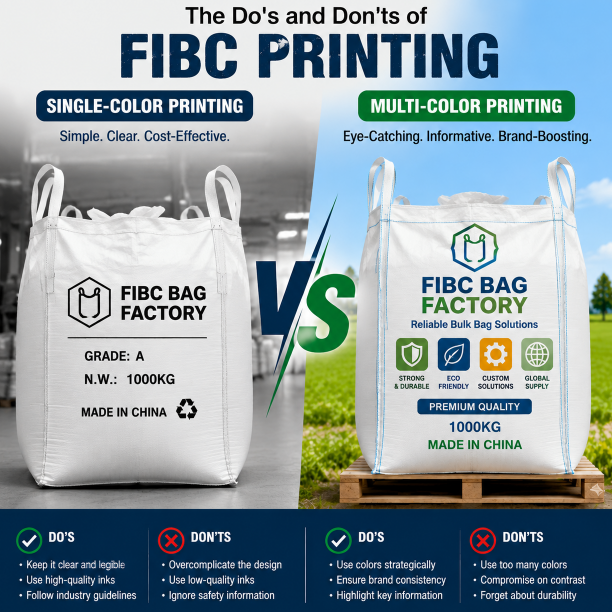
✅ Do’s: Expert-Backed
- ✔️ Use vector artwork — AI, EPS, or high-res PDF. Avoid raster images.
- ✔️ Specify ink type — water-based flexo for indoor, UV-flexo for outdoor (better UV resistance).
- ✔️ Include a “bleed” area — at least 10mm from the seam to avoid ink migration.
- ✔️ Ask for a strike-off — a physical print sample on actual FIBC fabric. Approve it before mass production.
- ✔️ Consider bag orientation — place your logo on both large panels for maximum visibility when stacked.
❌ Don’ts: Common Pitfalls
- ✖️ Don’t use process colors (CMYK) for flexo—it’s expensive and fades fast.
- ✖️ Don’t place critical text near the filling spout — it gets obscured by the duct.
- ✖️ Don’t ignore substrate tension — printing on woven fabric requires special anilox rolls. Not all printers can do it well.
- ✖️ Don’t overcomplicate — too many colors or fine details will increase cost and reduce legibility.
- ✖️ Don’t assume “one size fits all” — different PP yarn densities affect ink absorption. Always test.
6. Final Takeaways & Expert FAQ
To sum it up: Choose flexo over offset, prioritize UV-stable pigments, and design bold, high-contrast logos. Your FIBC printing is an investment in brand equity and operational efficiency—treat it as such.
💡 Quick-reference cheat sheet for your next order:
- Flexo ≥ Offset for FIBC
- UV-stable pigments (min. Blue Wool 6)
- 1 or 2 colors max for readability
- Always request a printed sample
- Test contrast in warehouse light
- Place logos on both sides
❓ Frequently Asked Questions
- Q: Can I print a 3-color logo with flexo?
- A: Yes, but each additional color adds plate cost and setup time. For most applications, 2 colors offer the best ROI. If you need 3+, consider shrink sleeves or labels instead.
- Q: How long does flexo ink last outdoors?
- A: With UV-stable pigments, you can expect 12–18 months of acceptable color retention in moderate climates. In extreme UV (e.g., Arizona), ask for our “desert-grade” ink formulation.
- Q: What’s the minimum line thickness for a logo?
- A: For flexo on woven PP, keep line thickness ≥ 2mm for solid reproduction. Anything thinner may break up or fill in.
📌 Still unsure? Our in-house printing specialists offer free artwork review for bulk orders. We’ll analyze your design and suggest optimizations for printability, durability, and cost—no obligation.