
If you’ve ever found yourself searching “how big is a bulk bag?” or “what is the standard bulk bag size?”, you’re not alone. These are among the most common questions we hear at FIBC Bag Factory. The truth is, while there are standard sizes, the “right” size depends entirely on your product and needs.
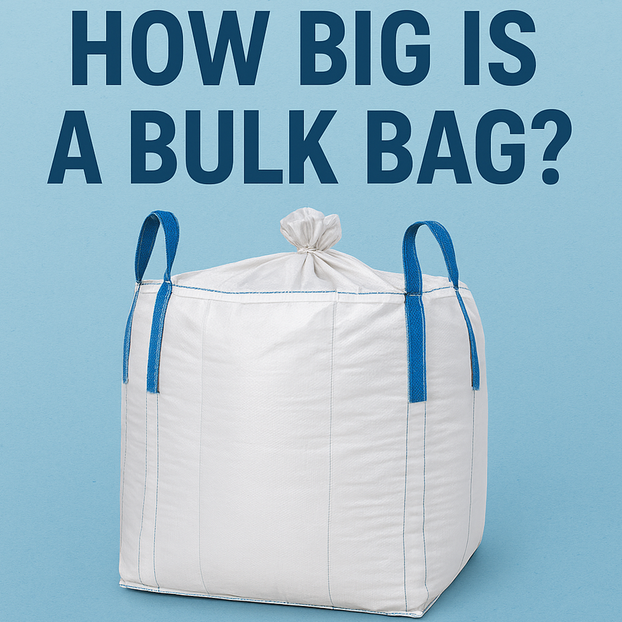
This ultimate guide will clear up all the confusion. We’ll break down bulk bag dimensions, weight capacities, and the key factors you need to consider before ordering.
First, What is a Bulk Bag?
A Bulk Bag, also known as a Flexible Intermediate Bulk Container (FIBC), FIBC bag, or a “builder’s bag,” is a large, industrial container designed for storing and transporting dry, flowable products like sand, gravel, grains, chemicals, and fertilizers. They are a cost-effective and efficient alternative to rigid containers like drums or boxes.
The “Standard” Bulk Bag Size: A Starting Point
Let’s address the most popular search: “how big is a standard bulk bag?”
A typical, common standard bulk bag has the following dimensions and capacity:
- Dimensions: 90 cm x 90 cm x 90 cm (35″ x 35″ x 35″). This is the most prevalent cubic shape.
- Weight Capacity: Designed to safely carry up to 1,000 kg (or 1 ton / 2,200 lbs).
- Volume Capacity: Typically holds about 1 cubic meter (m³), which translates to roughly 1,000 liters.
However, calling this the “only” standard is misleading. The industry has evolved to create bags for various specific purposes.
A Closer Look at Bulk Bag Dimensions & Capacity
Bulk bag sizes are a relationship between physical dimensions (size) and safe working load (weight). The size is often described by its volume in cubic meters (m³) or liters, while the weight is measured in kilograms (kg) or pounds (lbs).
Here is a quick-reference table for the most common bulk bag sizes:
| Common Name | Typical Dimensions (L x W x H) | Volume | Typical Safe Working Load (SWL) | Common Uses |
|---|---|---|---|---|
| Standard / 1-Ton Bag | 90 x 90 x 90 cm | ~1.0 m³ / 1,000 L | 1,000 kg / 2,200 lbs | Sand, Gravel, Fertilizer, General Industry |
| 850kg Builders Bag | 90 x 90 x 90 cm | ~1.0 m³ / 1,000 L | 850 kg / 1,870 lbs | Very common in construction. Filled with sand, ballast, or aggregates that have a specific density fitting this weight. |
| Mini Bulk Bag | 80 x 80 x 80 cm (or smaller) | ~0.5 – 0.8 m³ | 500 kg / 1,100 lbs | Smaller batches, heavier-density materials, limited storage space. |
| Jumbo / 2-Ton Bag | 100 x 100 x 110 cm | ~1.5 m³ | 1,500 – 2,000 kg | Lightweight, low-density products like plastic pellets or recycled materials. |
Answering Your Specific Questions
How big is an 850kg bulk bag?
Surprisingly, an 850kg bulk bag is often the same physical size as a standard 1-ton bag (90x90x90 cm). The difference is in the Safe Working Load (SWL) rating. Construction materials like sharp sand or ballast have a high density, meaning a 1-cubic-meter bag can reach its weight limit before it’s physically full. Therefore, an 850kg SWL bag is perfectly suited and safer for these specific, heavy materials, preventing overloading.
How big is a mini bulk bag?
A mini bulk bag is significantly smaller than the standard. You can expect dimensions around 80 x 80 x 80 cm or even 70x70x70 cm, with a volume of roughly 0.5 to 0.8 cubic meters. They are ideal for smaller orders, products with very high density (like metal powders), or when warehouse space is limited.
How big is a builder’s bulk bag?
A builder’s bulk bag is essentially the same as the standard 90x90x90 cm bag, typically with a capacity of 1 cubic meter. In the UK and other markets, it’s often sold as an “850kg builders bag” for the reasons mentioned above. It’s the go-to choice for construction sites for aggregates, sand, and rubble.
The Most Important Factor: Your Product’s Density
You cannot choose a bag based on dimensions or weight alone. The critical piece of information you need is your product’s density (mass per unit volume).
Use this simple formula:Density (kg/m³) = Weight (kg) / Volume (m³)
Example:
If your product has a density of 800 kg/m³:
- A 1 m³ bag will hold 800 kg of your product.
- You do not need a bag rated for 1,000 kg. A bag with an 850 kg SWL would be perfect.
If your product has a density of 1,200 kg/m³:
- A 1 m³ bag would be overloaded at 1,200 kg (exceeding the standard 1,000 kg SWL).
- You would need to either:
- Use a bag with a higher SWL (e.g., 1,500 kg).
- Underfill the standard bag to only 0.8 m³ to stay within the 1,000 kg limit.
Beyond Size: Other Crucial Considerations
At FIBC Bag Factory, we know that size isn’t everything. When you request a quote, we may also ask about:
- Lifting Loops: 2-loop, 4-loop, or cross-corner loops? This affects lifting stability.
- Liner Type: Do you need a food-grade, moisture-proof, or static-protective liner?
- Fabric Type: Are you packing a non-hazardous material (Type A) or one that requires static protection (Type C, for combustible dusts)?
- Discharge Options: Spout, duffle top, open top? This affects how you fill and empty the bag.
Conclusion: There’s No One-Size-Fits-All Answer
So, how big is a bulk bag? The answer is: It depends on your product.
- For general construction and aggregates, the 90x90x90cm, 850-1000kg SWL bag is the workhorse.
- For smaller quantities or high-density materials, a Mini Bulk Bag is the solution.
- For lightweight, bulky items, a Jumbo Bag with a larger volume is ideal.
Still unsure? Let us, the experts, help you!
At FIBC Bag Factory, we don’t just sell bags—we provide solutions. Tell us about your product, its density, and your handling requirements, and we will recommend the perfect bulk bag size, type, and specification for your needs.
Contact Us Today for a Free, No-Obligation Quote!