
📑 Article Navigation
Jump directly to any section:
- Introduction: The Non-Negotiable Safety Margin
- 1. What is Safety Factor (SF) in FIBC Bags?
- 2. Common Safety Factor Ratios in the FIBC Industry
- 3. How to Select the Right Safety Factor: A Decision Framework
- Quick-Selection Reference Table
- 4. Common Pitfalls to Avoid
- Conclusion: Safety Factor is an Investment, Not a Cost
🔑 Key Takeaways
- Safety Factor (SF) is the ratio between a bag’s breaking strength and its Safe Working Load (SWL)
- The industry standard for most applications is 5:1 to 6:1 (EFIBCA recommendation)
- Choosing the right SF depends on your product type, handling conditions, and reuse requirements
- A lower SF (<4:1) should only be used in strictly controlled, single-use scenarios
- Always consult with your FIBC manufacturer for application-specific recommendations
Introduction: The Non-Negotiable Safety Margin
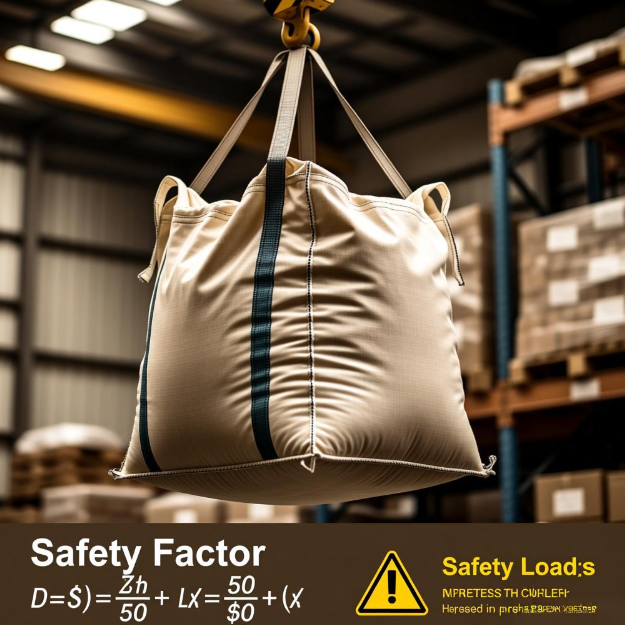
In the world of Flexible Intermediate Bulk Containers (FIBCs or bulk bags), the Safety Factor (SF) is not just a number—it’s the fundamental engineering principle that stands between routine handling and catastrophic failure. Selecting the correct SF is a critical decision that impacts operational safety, bag longevity, and total cost of ownership.
⚠️ Critical Warning:
A dangerously common misconception is equating a bag’s Safe Working Load (SWL) with its breaking strength. This guide will clarify what Safety Factor truly means, explore standard ratios in the FIBC industry, and provide a clear framework to help you select the optimal SF for your specific application.
1. What is Safety Factor (SF) in FIBC Bags?
The Safety Factor (SF), also known as the design factor, is the ratio between the minimum breaking strength of the FIBC and its stated Safe Working Load (SWL).
📊 Practical Example:
If a bag has an SWL of 1,000 kg and a Safety Factor of 5:1, it means:
- SWL: You can safely load up to 1,000 kg
- Minimum Breaking Strength: The bag is designed to withstand at least 5,000 kg before failure
Why This Buffer Is Crucial
The SF accounts for real-world variables that a static SWL cannot:
- Dynamic Forces: Shock loading during lifting, sudden stops, or lowering
- Material Fatigue: Weakening of the fabric over multiple filling/discharge cycles
- Environmental Stress: UV degradation, moisture, or chemical exposure
- Operational Variables: Uneven filling, slight overfilling, or accidental impact
In essence, the Safety Factor is your engineered margin of safety against the unpredictable.
2. Common Safety Factor Ratios in the FIBC Industry
While custom ratios exist, the FIBC industry largely operates within a recognized range of standard Safety Factors. The chosen standard often aligns with the destination market’s guidelines or the specific risk profile of the contents.
| Safety Factor (SF) | Common Designation | Typical Applications & Notes |
|---|---|---|
| 5:1 / 6:1 | Standard / General Duty | The most common and widely recommended range. Suitable for most general-purpose materials (e.g., plastics, granules, many chemicals) under normal handling conditions. Often aligns with EFIBCA (Europe) and many other international guidelines. |
| 7:1 | Heavy-Duty / High-Risk | Used for heavier, denser, or sharper materials (e.g., some minerals, metal parts). Recommended for more demanding handling cycles, longer lifespans, or when dynamic forces are expected to be higher. |
| 8:1 | Premium / Specialized | Applied for critical applications, such as certain food-grade products where contamination from failure is unacceptable, or for valuable materials. May be specified by stringent corporate safety policies. |
| 4:1 | Light-Duty / Controlled Use | Used only under strictly controlled conditions for very lightweight, non-abrasive materials and predictable, gentle handling (e.g., automated filling/discharge in a consistent environment). Not recommended for general use. |
🌍 Key Standard Reference:
The European Federation of FIBC Manufacturers (EFIBCA) Code of Practice is a globally influential document. It explicitly recommends a minimum 5:1 safety factor based on the dynamic forces measured during typical lifting and filling operations.
3. How to Select the Right Safety Factor: A Decision Framework
Choosing the correct SF is a risk assessment exercise. Work with your FIBC supplier and ask these key questions:
A. Assess Your Product Characteristics
- Density & Weight: Is your product heavy for its volume? Higher density often warrants a higher SF (e.g., 6:1 or 7:1)
- Abrasiveness: Does the product have sharp or jagged particles (e.g., sand, certain minerals)? Abrasion accelerates wear, requiring a higher SF to maintain safety over the bag’s life
- Flowability: Does it flow freely or compact? Products that settle unevenly can create unexpected stress points
B. Evaluate Your Handling & Environmental Conditions
- Lift Dynamics: Are lifts smooth and controlled, or are they prone to jerking, swinging, or sudden drops? More dynamic environments demand a higher SF
- Number of Uses: Is the bag for single-trip or multiple reuses? For reuse, a higher SF (e.g., 6:1 or 7:1) is mandatory to account for fatigue
- Filling/Discharge Method: Automated systems are generally gentler than manual methods. Check for potential hook damage during lifting or stress during discharge
- Storage Conditions: Will bags be stacked? Stacking increases pressure on lower bags. Will they be exposed to UV sunlight, moisture, or extreme temperatures? Environmental degradation necessitates a higher safety margin
C. Consider Regulatory & Safety Policy Requirements
- Industry Standards: Does your company or industry (e.g., pharmaceuticals, food) have internal safety policies mandating a specific SF?
- End-Customer Requirements: Your client’s receiving guidelines may specify a minimum SF
- Insurance Implications: Using bags with an insufficient SF could compromise insurance coverage in the event of an accident
📋 Quick-Selection Reference Table
| If your application involves… | Consider this Safety Factor… | Primary Reason… |
|---|---|---|
| General-purpose powders/granules, normal handling, single trip | 5:1 | Meets international best practices for standard use |
| Reusable bags, denser materials, or moderately rough handling | 6:1 | Provides extra margin for fatigue and dynamic forces |
| Abrasive materials (sand, minerals), high-value contents, or demanding multi-trip cycles | 7:1 | Maximizes safety and longevity against wear and stress |
| Lightweight, non-abrasive products in a fully controlled, automated environment | 4:1 (Use with Caution) | Minimizes cost where risk is proven to be exceptionally low |
4. Common Pitfalls to Avoid
- Prioritizing Price Over SF: Choosing a bag with a lower SF might seem cost-effective but dramatically increases the risk of failure, product loss, and liability
- Confusing SWL with Breaking Strength: Always ask for both the SWL and the SF. A “2-ton bag” is meaningless without knowing its safety margin
- Assuming “One Size Fits All”: The same product handled differently (e.g., shipped vs. stored in-house) may need a different SF
- Neglecting the Supplier’s Expertise: A reputable FIBC manufacturer (like FIBC Bag Factory) can analyze your specific use case and provide a professional SF recommendation
Conclusion: Safety Factor is an Investment, Not a Cost
Selecting the right Safety Factor is a fundamental component of responsible supply chain management. It is an investment in safety, reliability, and operational continuity.
🏭 At FIBC Bag Factory, we don’t just sell bags; we provide engineered solutions.
Our technical team is ready to help you navigate this critical decision, ensuring the FIBCs you receive are perfectly matched to your product, processes, and risk tolerance—with the appropriate Safety Factor clearly certified.
Ready to Specify the Right Bag for Your Needs?
Contact our experts today for a free, no-obligation technical consultation. Let us help you calculate the optimal Safety Factor for your specific application.
📧 Email: [email protected]
🌐 Website: https://www.fibcbagfactory.com
📞 Tel: (+86)15985817329