
📑 Table of Contents
1. Foreword
Flexible Intermediate Bulk Containers (FIBC), commonly known as bulk bags, ton bags, or jumbo bags, are large-scale flexible packaging containers manufactured primarily from woven polypropylene (PP) fabric through sewing or heat-sealing processes. FIBCs are prized for their high loading capacity, cost-effectiveness, space-saving storage, and ease of handling. They are widely utilized across chemical, construction, agricultural, fertilizer, mining, pharmaceutical, and new energy material sectors for dry-flowable bulk material packaging and logistics.
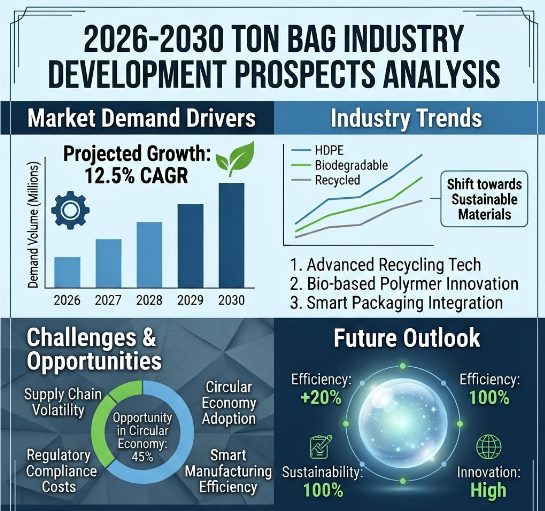
In 2026, the global FIBC industry stands at a historic inflection point. Geopolitical shifts reshaping supply chains, the “Dual Carbon” goals driving green transformation, and the explosive growth of the new energy sector generating premium demand—these converging forces are propelling this traditional manufacturing industry toward a new phase of high-end, green, and intelligent development. This white paper aims to comprehensively outline the current state, market scale, competitive landscape, regulatory environment, and technological trends of the global and Chinese FIBC industry in 2026, providing strategic references for industry stakeholders.
2. Global Market Size & Growth Forecast (2026–2030)
2.1 Overall Market Size
In 2026, the global FIBC market maintains a robust growth trajectory. Data from leading international research institutions indicates:
- Future Market Insights (FMI): The global FIBC market was valued at $6.6 billion in 2025 and is projected to reach $6.9 billion in 2026, aiming for $10.4 billion by 2036, with a CAGR of 4.20%.
- Global Info Research: The global FIBC output value is expected to reach $20.28 billion by 2032, with a CAGR of 5.8% from 2026 to 2032.
- Research and Markets: The market grew from $13.64 billion in 2025 to $14.69 billion in 2026, targeting $23.44 billion by 2032, at a CAGR of 8.03%.
- QYResearch: Global FIBC bulk packaging bag sales reached ¥81.5 billion CNY in 2025 and are projected to hit ¥115.79 billion CNY by 2032, with a CAGR of 5.3%.
Consensus Forecast: The global FIBC market size in 2026 is estimated between $6.9 billion and $14.7 billion (depending on statistical scopes), with a long-term CAGR of 5%–8%.
2.2 Segmented Product Market Size
Based on electrostatic protection levels and functional characteristics, FIBC products are categorized into Types A, B, C, and D:
- Type A (Standard Bags): Basic FIBCs for non-hazardous, non-static-sensitive materials. 2025 global market: $2.909 billion. Projected 2032: $4.054 billion (CAGR 4.9%). Production volume hit 912 million units, with an average price of ~$3.10/unit.
- Type B (Low Breakdown Voltage Bags): Suitable for standard chemical powders and food powders. 2025 market: $793 million. Projected 2032: $1.126 billion (CAGR 5.2%). From 2027 onward, more countries will mandate breakdown voltage test reports for powder packaging.
- Type D (Static Dissipative Bags): Manufactured with anti-static base fabric for explosive environments. 2025 market: $469 million. Projected 2032: $772 million (CAGR 7.6%) – the fastest-growing segment.
- 1-Ton FIBC Bags: Standard specification. 2025 global market: $5.538 billion. Projected 2032: $8.394 billion (CAGR 6.3%).
- Conductive FIBCs: In 2026, the global conductive FIBC market is valued at ¥14.1 billion CNY, projected to hit ¥21.1 billion CNY by 2033 (CAGR 5.91%). In USD, valued at $1.21 billion in 2025, expected $1.3 billion in 2026 (CAGR 8.39%), reaching $2.14 billion by 2032.
2.3 Regional Market Landscape
Production: Europe is the largest FIBC supplier (~29% market share), followed by Asia (including China) at ~25%. Consumption: The Asia-Pacific region holds a dominant position in global consumption, while North America (US, Canada, Mexico) and Europe (Germany, France, UK) remain critical consumption hubs.
The United States accounts for nearly 38% of the conductive FIBC consumption market, with Europe at ~30%. North American and European markets strictly emphasize CE and FDA certifications as key market entry barriers.
China Market: In 2025, the domestic FIBC market exceeded ¥38 billion CNY, with an annual growth rate stabilizing above 6.5%. Shandong, Jiangsu, and Zhejiang coastal provinces form major industrial clusters—Shandong alone accounts for nearly 25% of national production capacity.
3. Policy Environment & Industry Standards
3.1 National Standard Upgrade (China)
In August 2025, the updated national standard GB/T 10454-2025 was officially released, replacing GB/T 10454-2000 and GB/T 37425-2019, effective March 1, 2026. Modified in alignment with ISO 21898:2024, the new standard introduces:
- Clearer Classification: Differentiates between single-trip and reusable FIBCs for the first time.
- Material Sustainability: Allows the use of recycled materials with more than 95% identical polymers.
- Stricter Technical Requirements: Adds dimensional tolerances and mandates anti-static performance per IEC 61340-4-4.
- Enhanced Labeling: Requires manufacturer details, product numbers, rated load, safety factor, and maximum stacking quantity on tags.
3.2 EU Packaging Regulations (PPWR)
In 2026, the EU Packaging and Packaging Waste Regulation (PPWR, EU/2025/40) will fully take effect on August 12. It imposes strict heavy metal limits (≤100 mg/kg) and bans PFAS in food-contact FIBCs, with zero-tolerance for non-compliant cargo. It also mandates a 55% packaging recycling rate by 2030.
3.3 Green Trade Policies
In January 2026, China’s Ministry of Commerce issued the “Implementation Opinions on Expanding Green Trade,” explicitly directing foreign trade enterprises to use eco-friendly packaging and reduce secondary packaging, promoting international mutual recognition of unitized container equipment. The “Dual Carbon” strategy encourages the adoption of recycled materials and biodegradable materials in packaging manufacturing.
4. Top 20 Global FIBC Manufacturers
The global FIBC competitive landscape is characterized by a multi-polar structure with low market concentration. The top 5 conductive FIBC manufacturers hold approximately 14% of the market share. No single enterprise dominates the industry.
Top 20 Global Manufacturers (Alphabetical/Ranked):
- 1. Ameriglobe (North America)
- 2. BAG Corp (Global)
- 3. Bulkcorp International (Australia/Asia-Pacific)
- 4. Conitex Sonoco (Global)
- 5. Emmbi Industries (India)
- 6. FIBC Bag Factory (Global)
- 7. Flexituff (India)
- 8. Global-Pak (International)
- 9. Greif (Global industrial packaging leader)
- 10. Intertape Polymer Group (North America)
- 11. Isbir (Turkey)
- 12. Japan Matte Group (Japan/Asia)
- 13. Kanpur Plastipack Limited (KPL) (India)
- 14. Minini SpA (Europe)
- 15. National Bulk Bag (USA)
- 16. Palmetto Industries (USA)
- 17. Rishi FIBC Solutions (India)
- 18. Southern Packaging (USA)
- 19. Taihua Jumbo Bags (China)
- 20. Yixing Weini Te Packaging Bags (China)
5. Industry Chain Structure
The FIBC industry chain consists of three primary tiers:
- Upstream (Raw Materials): Polypropylene (PP) resin, PP tapes, UV stabilizers, masterbatches, anti-static agents, conductive yarns, PE/Al/EVOH liners, sewing threads, lifting loops, labels, inks, and pallets. PP accounts for over 80% of fabric costs, making it the primary cost driver.
- Midstream (Manufacturing): Tape extrusion, weaving, coating/laminating, compounding, cutting, printing, sewing, liner fitting, electrostatic/load/drop testing, and final inspection.
- Downstream (Applications): Chemicals, agriculture, food, pharmaceuticals, mining, construction, plastics, logistics, and recycling. The chemical and pharmaceutical sectors represent the largest application area, accounting for nearly 60% of FIBC demand.
Industry gross margins typically range between 20% and 35%.
6. Key Development Trends (2026–2030)
6.1 Green Transformation & Circular Economy
The industry is shifting from virgin PP to high-performance, sustainable materials. PP still dominates (~78% of production share), but rPP and rPET integration is reshaping strategies. The “bottle-to-bag” recycling technology (converting PET waste into durable woven fabric) is reducing virgin plastic dependency while opening premium market segments.
In 2026, 65% of global buyers explicitly require at least 25% recycled polypropylene (rPP) content in their procurement. Major players like Greif recycled/refurbished over 4.5 million containers in 2025, accelerating the shift from single-use to multi-trip circulation models.
6.2 Premiumization & Specialty Functional Products
High-value industries (chemicals, new energy, pharmaceuticals) are driving surging demand for specialty FIBCs: high-cleanliness, anti-static, and flame-retardant products for lithium battery materials, food, and medicine. Companies like Guizhou Hai Chuang Yi Heng are pivoting into the lithium battery logistics niche, upgrading cleanroom facilities and expanding into functional FIBCs and aluminum foil inner bags.
6.3 Smart Manufacturing & Digitalization
Integrated sensors and RFID tags enable real-time packaging monitoring, dynamic inventory management, and logistics optimization. At Interpack 2026, major players showcased high-strength, lightweight woven fabrics (15% material reduction while maintaining 5:1 safety factor) and RFID-integrated smart FIBCs. Smart, sustainable FIBCs have become mainstream buyer requirements.
6.4 Safety Standard Upgrades
From 2027 onwards, more countries will mandate breakdown voltage test reports for powder packaging, accelerating the Type B to Type A bag substitution. UN-certified FIBCs (13H1–13H4 types) require compliance with IEC 61340-5-1 and IMDG/ADR regulations. In 2026, 90% of cross-border shipments require full load test reports.
6.5 China’s Industry Status Consolidation
China remains the world’s largest FIBC exporter, accounting for 38% of global production in 2026. Leveraging its complete industrial chain and cost advantages, China continues to solidify its position as the global production center, with leading manufacturers strictly adhering to GB/T 10454-2025 and ISO 21898:2024.
7. Challenges & Outlook
7.1 Main Challenges
- Raw Material Price Volatility: PP accounts for >80% of fabric costs, making the industry highly sensitive to oil prices and PP supply-demand dynamics.
- International Trade Uncertainty: U.S. tariff adjustments and rising trade protectionism create significant volatility for export-oriented enterprises.
- Homogeneous Competition: The traditional universal product market faces intense price competition, squeezing profit margins.
- Environmental Compliance Costs: New national standards, EU PPWR, and mandatory recycled content requirements impose substantial compliance costs on SMEs.
7.2 Development Outlook (2026–2032)
- Market Expansion: Global market is expected to exceed $20 billion by 2032 with a 5%–8% CAGR.
- High-End Transition: Demand for specialty FIBCs in new energy, pharmaceuticals, and food will accelerate.
- Green Competitiveness: Recycled material ratios, carbon footprint, and circular recovery systems become key differentiators.
- Intelligent Upgrading: IoT and automation will shift the industry from labor-intensive to technology-driven.
8. Conclusion
In 2026, the FIBC industry stands at a pivotal moment of transformation. The implementation of GB/T 10454-2025 sets higher quality benchmarks, the EU PPWR raises export compliance requirements, green trade policies guide sustainable development, and emerging industries like new energy open vast growth avenues. Enterprises must accelerate technological innovation, optimize product portfolios, deepen green transitions, and elevate smart manufacturing capabilities to seize opportunities in the global competitive landscape.
9. FAQ (Frequently Asked Questions)
Q1: What is the difference between Type A, B, C, and D FIBC bags?
A: Type A are standard non-static protective bags. Type B have low breakdown voltage for powder safety. Type C (conductive) require grounding. Type D are static dissipative and do not require grounding, ideal for explosive environments.
Q2: What is the current market size of the global FIBC industry in 2026?
A: The market is estimated between $6.9 billion and $14.7 billion depending on the reporting agency’s scope, with a consensus long-term CAGR of 5–8% through 2032.
Q3: What are the key regulations affecting FIBC exports in 2026?
A: China’s GB/T 10454-2025 (effective March 1, 2026) and the EU PPWR (effective August 12, 2026) are the most critical. Exporters must comply with heavy metal limits, PFAS bans, and recycled content requirements.
Q4: Which regions are the fastest-growing markets for FIBCs?
A: The Asia-Pacific region is the fastest-growing in terms of consumption. Southeast Asia and South America are emerging as core incremental markets due to infrastructure development and commodity trade.
Q5: How is sustainability impacting FIBC manufacturing?
A: Sustainability is now a core competitive factor. Over 65% of global buyers require at least 25% recycled content (rPP). “Bottle-to-bag” technologies and multi-trip circulation models are becoming industry standards.
Disclaimer: This white paper is compiled based on publicly available market research reports, government policy documents, and industry analysis materials. It is for informational reference only and does not constitute investment advice. All data sourced from cited research institutions.