
Your FIBC is only as good as its liner. The woven polypropylene outer bag provides structure—but it’s the inner liner that safeguards your product from moisture, contamination, oxygen, and static hazards. With the wrong liner, you risk product spoilage, regulatory non-compliance, and costly material loss. This guide distills factory-floor expertise to help you select the perfect liner for your bulk material—whether you’re handling food-grade powders, hygroscopic chemicals, or abrasive minerals.
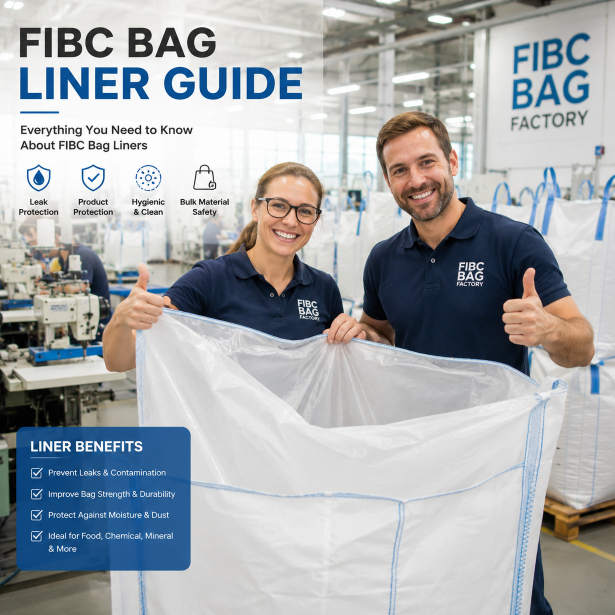
1. Why Use a Liner? The Core Benefits
An FIBC liner is a flexible, protective bag placed inside the bulk bag, acting as an inner barrier between your product and the woven polypropylene outer fabric. Here’s what a liner delivers:
Contamination Control
Prevents cross-contamination and protects from dust and debris
Moisture & Oxygen Barrier
Specialized liners block environmental factors that degrade sensitive goods
Smoother Discharge
Reduces product residue and hang-ups, minimizing waste
Beyond these, liners are often a regulatory requirement for meeting FDA food-contact regulations or UN certifications for hazardous materials. Simply put: if your product has value, it deserves a liner.
2. Liner Types by Shape: Form-Fit vs. Tubular vs. Baffle
The shape of your liner determines how well it fits, fills, and discharges. Here’s the breakdown:
Our verdict: For most applications, form-fit liners offer the best ROI—they improve product containment, reduce waste, and can hold 15–20% more product compared to standard liners. Choose tubular only if cost is your primary constraint and your product isn’t moisture-sensitive.
3. Material Matters: PE, PP, EVOH, Aluminum & Nylon
Liner material determines barrier performance, durability, and cost. Here’s your material cheat sheet:
🟢 Polyethylene (PE)
The workhorse. LDPE for flexibility, LLDPE for strength, HDPE for rigidity. Excellent moisture barrier, cost-effective, FDA-compliant options available.
Best for: General-purpose, food-grade, moisture protection
🔵 Polypropylene (PP)
High tensile strength, puncture-resistant. Ideal for heavy-duty products like cement, sand, and minerals.
Best for: Heavy-duty, abrasive materials
🟡 EVOH (Barrier Layer)
Exceptional oxygen barrier. Used as a co-extruded layer (5–7 layers) to extend shelf life of food products.
Best for: Oxygen-sensitive food, pharmaceuticals
🔴 Aluminum / Foil
Ultimate barrier against moisture, oxygen, light, and odor. Provides UV protection.
Best for: High-value, extremely sensitive products
Pro tip: For food-grade applications, always specify FDA-compliant films (21 CFR 177.1520). Our food-grade liners are manufactured in clean-room environments using only FDA-approved materials.
4. Thickness & Barrier Performance
Liner thickness is measured in mils (1 mil = 25.4 microns). Here’s a practical guide:
- 2–3 mil: Light duty, general-purpose
- 3–4 mil: Common middle ground
- 4–6 mil: Heavy duty, higher abuse resistance
- 6+ mil: High protection, specialty use
For most FIBC applications, 4 mil is the sweet spot—offering robust puncture resistance without excessive cost. For hygroscopic materials, pair thickness with a high-barrier material like EVOH or aluminum.
5. Static Protection: Type C, D & Liner Compatibility
If you’re handling flammable powders or fine materials in explosive environments, static protection is non-negotiable. FIBCs are classified as Type C or Type D:
⚡ Type C (Conductive): Interwoven with conductive threads; requires grounding to safely dissipate static charges.
⚡ Type D (Static Dissipative): Made from static-protective fabric; no grounding required—eliminates human error risk.
Your liner must be compatible with the bag type. Antistatic liners are available for Type B, C, and D FIBCs. For Type C bags, the liner should not interfere with the grounding path. We recommend consulting with our technical team to ensure full compatibility.
6. Liner vs. Coating: What’s the Difference?
This is a common point of confusion. Here’s the distinction:
📦 Liner (Recommended)
- Separate inner bag inserted into the FIBC
- Superior protection against contamination and moisture
- Can be removed and replaced—allows bag reuse
- Can provide liquid barrier
🖌️ Coating (Economical Alternative)
- PP film laminated onto the bag fabric
- Seals gaps in the weave—prevents dusting
- Less protective than liners
- More economical; no liquid barrier
Our recommendation: Choose a liner for any product that requires true protection against moisture, oxygen, or contamination. Choose coating only for dry, non-sensitive powders where cost is the primary driver.
7. How to Choose: A Step-by-Step Framework
Use this 4-step framework to select the right liner for your bulk material:
- Step 1: Assess your product’s sensitivity
- Moisture-sensitive? → PE or aluminum liner
- Oxygen-sensitive? → EVOH or nylon liner
- Flammable/fine powder? → Antistatic or conductive liner
- Step 2: Choose the shape
- Need clean discharge and shape retention? → Form-fit
- Budget constraint? → Tubular
- Need square shape for stacking? → Baffle
- Step 3: Select thickness
- Standard: 3–4 mil
- Abrasive/heavy: 4–6+ mil
- Step 4: Verify regulatory compliance
- Food contact? → FDA 21 CFR compliance
- Hazardous materials? → UN certification
💡 Still unsure? Our technical team offers free liner consultations. Send us your product specifications, and we’ll recommend the optimal liner—no obligation.
8. Final Takeaways & Expert FAQ
To summarize: choose form-fit for performance, PE for versatility, and always verify barrier properties against your product’s needs. Your liner is the last line of defense for your product’s quality—don’t compromise.
❓ Frequently Asked Questions
- Q: Can I reuse a liner?
- A: Liners are typically single-use. However, when combined with a multi-use FIBC (6:1 or 8:1 safety ratio), the liner can be removed and replaced with a new one—allowing the outer bag to be reused.
- Q: What’s the difference between a form-fit liner and a tubular liner?
- A: Form-fit liners are custom-shaped to the bag’s exact dimensions—they eliminate folds and traps, ensuring complete discharge. Tubular liners are simple cylinders; they’re cheaper but prone to shifting and product retention.
- Q: Do I need a liner if my FIBC is already coated?
- A: It depends. Coating seals the weave gaps but doesn’t provide the same level of protection as a liner. For moisture-sensitive or high-value products, a liner is still recommended.
- Q: How do I know if I need an antistatic liner?
- A: If you’re handling fine powders or flammable materials in environments with explosion risks, you need static protection. Consult our team for a risk assessment.