
Introduction: Why Firewood Storage Matters More Than You Think
If you heat with wood—or sell it—you already know the frustration. You split a season’s worth of logs, stack them by hand, wait months, then unstack them one by one when winter arrives. Traditional firewood management is labor-intensive, space-hungry, and unforgiving of mistakes. Get the seasoning wrong, and you’re burning smoke instead of heat.
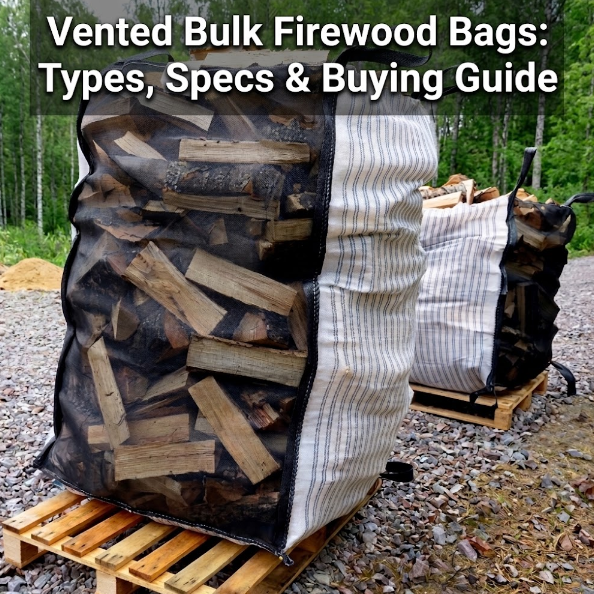
Vented bulk firewood bags have emerged as a practical alternative that addresses several of these pain points at once. These aren’t the flimsy net sacks you see at a petrol station. They’re industrial-grade flexible intermediate bulk containers (FIBCs) engineered with breathable mesh panels that allow air to circulate through the wood while it’s stored and transported. In essence, they let you season, store, and move firewood without ever restacking it.
But here’s what most product pages won’t tell you: vented bags are not a universal upgrade over traditional stacking. In certain conditions, they can actually slow down the drying process. Understanding when and why they work—and when they don’t—is the difference between a smart investment and an expensive storage experiment. This guide covers everything: what these bags are, how they perform in real-world conditions, their genuine advantages and limitations, and how to choose the right option for your situation.
What Are Vented Bulk Firewood Bags?
A vented bulk firewood bag is a large, breathable container made from woven polypropylene (PP) with mesh or ventilated fabric panels built into its sides. It functions as both a storage vessel and a seasoning environment for split firewood.
The term “vented bulk firewood bag” is often used interchangeably with “ventilated FIBC,” “mesh log bag,” and “breathable ton bag.” While these terms overlap significantly, they are not perfectly identical:
- Bulk firewood bags emphasize large capacity and commercial-scale storage. They typically hold 500 kg to 1,500 kg of wood and feature four lifting loops compatible with forklifts or tractor forks.
- Vented firewood bags emphasize air permeability. They may be large or small, and their defining feature is the mesh or ventilated fabric that promotes airflow.
- Ventilated FIBC is the industry-standard term for the industrial-grade version—a flexible intermediate bulk container with mesh panels, UV-stabilized fabric, and certified load ratings.
In practice, most products marketed as “bulk firewood bags” today include vented construction. The combination term—vented bulk firewood bags—most accurately describes the category.
How They Differ from Ordinary FIBCs
Standard FIBCs used for sand, gravel, or chemicals are made from densely woven, sometimes laminated fabric that is essentially airtight. That’s fine for inert materials, but catastrophic for firewood. Sealed in a non-breathable bag, green wood becomes a breeding ground for mould and rot. The vented variant solves this by replacing solid side panels with mesh or perforated fabric, allowing moisture to escape as vapour and air to flow through the stack.
Most vented firewood bags are constructed from 100% virgin polypropylene with a fabric weight between 170 and 200 gsm, treated with UV stabilizers to withstand prolonged outdoor exposure. They typically carry a safety factor of 5:1 or 6:1, meaning the bag is tested to hold five to six times its rated load.
The Seasoning Problem: Why Firewood Needs to Breathe
To understand why vented bags exist, you need to understand what firewood is actually doing while it sits in storage.
Freshly cut wood contains 40–50% moisture by weight. For safe, efficient burning, that moisture content needs to drop below 20%. Burning wet wood wastes energy on evaporating water, produces excessive creosote, and increases chimney fire risk. The drying process—seasoning—requires three things: time, air movement, and warmth.
Traditional seasoning involves stacking split logs loosely in a covered, well-ventilated structure. Air moves through the gaps between logs, carrying moisture away from the end grain. The key variables are airflow velocity and the surface area of exposed wood.
This is where vented bags enter the conversation. A well-designed vented bag provides 360-degree air access through mesh panels on all four sides. But—and this is the critical nuance—the logs inside a bag are loose-filled, not neatly stacked. That means air gaps are irregular and airflow through the interior of the bag is less directional than in an open stack. Some experienced firewood handlers report that drying time in bags can be longer than in traditional stacks, particularly in humid or still conditions.
The honest answer is: vented bags work best as a handling system first and a seasoning system second. They excel when paired with active air movement (wind, fans, or a greenhouse-like environment) and when the wood is pre-split to a small size that maximizes surface area.
Types of Vented Bulk Firewood Bags
Not all vented bags are built the same way. The construction directly affects airflow, structural strength, and suitability for different use cases.
By Ventilation Pattern
Full mesh (4-side mosquito mesh): All four sides are made from fine mesh fabric. Maximum airflow, lightest weight, and best for rapid initial drying. However, mesh fabric offers less structural reinforcement, so these bags are best suited for lighter loads (typically up to 1,000 kg) and less demanding handling conditions.
Ventilated fabric panels: Side panels are made from woven PP fabric with ventilation holes or strips. These offer a balance between airflow and structural integrity, and are the most common configuration for commercial firewood operations. Typical fabric weight is 170–200 gsm.
Hybrid construction (2-side mesh, 2-side solid): Two sides use mesh, two use solid woven fabric. This configuration provides directional airflow while maintaining greater bag rigidity. Some suppliers offer this for applications where the bag will be placed against a wall or in a row, allowing the mesh sides to face the prevailing wind.
By Handling Configuration
4-loop standard FIBC: The most common design. Four corner lifting loops allow forklift or crane handling. Suitable for stacking and palletized storage.
Log-Lift / form-stable bags: A proprietary design (notably from NNZ) with internal reinforcement that keeps the bag upright and stable even when partially empty. These are easier to fill evenly and less prone to collapsing during transport.
Bottom-discharge bags: Feature a discharge spout or tipping handle at the base for controlled emptying. Useful for commercial operations that need to feed wood into processing equipment.
By Capacity
| Tier | Typical Capacity | Typical Dimensions | Best For |
|---|---|---|---|
| Mini / barrow bag | 200–300 kg | 45 × 45 × 95 cm | Household use, manual handling |
| Standard builders bag | 500–750 kg | 90 × 90 × 90 cm | Small commercial, large household |
| Full bulk FIBC | 1,000–1,500 kg | 100 × 100 × 120 cm | Commercial firewood supply |
| Heavy-duty industrial | 1,500–2,000 kg | Custom | Large-scale distribution |
A standard 90 × 90 × 90 cm bag holds approximately 0.75 m³ of loose-filled firewood. Larger 100 × 100 × 120 cm bags hold approximately 1.2 m³.
Key Specifications and Features
Understanding the technical specifications helps you evaluate quality and avoid buying bags that will fail after a single season.
Fabric and Material
The industry standard is 100% virgin polypropylene woven fabric. Recycled PP (rPP) is increasingly common—the FIBC market reported over 25% rPP adoption in 2026, reducing carbon emissions by approximately 30% compared to virgin material. However, recycled fabric may have slightly lower tensile strength, so it’s worth verifying the safety factor if you’re handling heavy loads.
UV stabilization is non-negotiable for outdoor use. Untreated PP degrades rapidly in sunlight, becoming brittle within months. Quality bags include UV masterbatch added during the extrusion process, typically specified as “UV stabilized, suitable for prolonged outdoor sun exposure.” If a product description doesn’t mention UV treatment, assume it’s not there.
Safety Factor
The safety factor (SF) indicates the ratio between the bag’s tested failure load and its rated working load. For firewood, a 5:1 or 6:1 safety factor is standard. A 5:1 bag rated for 1,000 kg has been tested to 5,000 kg before failure. Lower safety factors (3:1) exist but are generally intended for single-use applications and are not suitable for reusable firewood storage.
Loops and Handling
Four corner lifting loops are standard. Loop width typically ranges from 5 cm to 10 cm, with reinforced cross-corner or side-seam attachment. If you plan to lift filled bags repeatedly, check that the loop attachment is sewn with double-chain or overlock stitching—plain stitching can fail under cyclic loading.
Some bags include a tipping handle at the base, which makes emptying significantly easier. Without one, you’ll need to tip the bag with a forklift or cut it open.
Top and Bottom Options
- Top: Open top (simplest, fastest filling), duffle top (weather protection), or filling spout (for automated filling systems).
- Bottom: Flat bottom (standard), discharge spout (controlled emptying), or fully open bottom (fastest dumping).
For firewood, open-top / flat-bottom is the most practical combination for most users.
Real Advantages and Honest Limitations
Advantage 1: Dramatically Reduced Handling Labour
This is the single biggest benefit, and it’s why commercial firewood operations have adopted these bags so widely. Instead of stacking, unstacking, and restacking logs through multiple stages, you fill a bag once and move it with a forklift or tractor. One firewood handler on a forestry forum described the Log-Lift bag method as “the quickest by far” compared to covered stacks or IBC totes, specifically because “there is no stacking.”
For a household burning 3–5 cords annually, the labour savings are meaningful but may not justify the equipment cost. For operations handling 10+ cords, the tipping point is clear—experienced users suggest that above 15 cords per year, reusable container systems become essential.
Advantage 2: Weather Protection Without Sacrificing Airflow
Unlike an open stack, a bag provides a physical barrier against rain, snow, and wind-driven moisture. The mesh panels allow moisture vapour to escape while blocking liquid water ingress from most directions. This is particularly valuable in climates with frequent freeze-thaw cycles, where surface moisture on exposed logs can refreeze and slow drying.
Advantage 3: Pest Deterrence
Open firewood piles are magnets for insects, rodents, and other pests. The enclosed structure of a vented bag—especially those with fine mesh—acts as a physical barrier that reduces infestation risk. For commercial sellers, this directly protects product quality and customer satisfaction.
Advantage 4: Space Efficiency and Stackability
Filled bags maintain a stable, roughly cubic shape that stacks neatly on pallets or directly on each other. This allows for denser storage than irregular hand-stacked piles. That said, some users note that storing bags takes up more floor space than a well-built stack, because you can’t fill the odd-shaped gaps around a stack as efficiently.
Advantage 5: Sustainability and Reusability
A quality vented FIBC can be reused for 5–10 seasons if handled carefully. At end of life, the polypropylene is 100% recyclable. This compares favourably to single-use net bags or plastic wrap used in retail firewood packaging.
The Honest Limitations
Limitation 1: Drying may be slower than an open stack in still conditions. This is the most important limitation and the one least discussed by bag manufacturers. In a well-ventilated stack with wind exposure, air moves freely through the entire wood mass. In a loose-filled bag, the exterior logs dry quickly, but logs in the centre of the bag experience reduced airflow. A hearth.com forum member put it bluntly: “They say ‘ventilated’ but I’d think drying time in the bags will go way up since air movement is cut to almost nothing, compared to stacking in the wind with a top cover.”
Limitation 2: Bottom loops can degrade. Several users report that the lifting loops on the bottom of bags—used for tipping and emptying—become weak after a season of outdoor exposure. They “work when the bags are new” but may fail after prolonged UV and weather exposure. If you plan to reuse bags for multiple seasons, inspect loops annually.
Limitation 3: The “ton bag” terminology is misleading. In the firewood trade, these bags are commonly called “ton bags,” but this refers to the bag size, not the weight of its contents. Seasoned softwood is lightweight—a literal metric tonne would overflow the bag significantly. Always buy firewood by volume (cubic metres or cubic feet), not by weight, when using bulk bags.
Limitation 4: Volume shrinks after stacking. Logs loose-filled in a bag occupy more volume than the same logs neatly stacked. Expect approximately 30–40% volume reduction when you remove logs and stack them tightly. This isn’t a shortfall—it’s physics. But it’s worth understanding before you compare the cost-per-cord of bagged versus stacked firewood.
How to Choose the Right Bag
Choosing well comes down to matching the bag to your specific workflow. Here’s a decision framework:
Step 1: Estimate Your Annual Volume
| Annual Usage | Recommended Approach |
|---|---|
| Under 2 cords | Stick with traditional stacking or small net bags |
| 2–5 cords | Standard 500–750 kg vented bags, manual handling |
| 5–15 cords | 1,000 kg FIBCs, invest in a pallet fork or small tractor |
| 15+ cords | Full commercial setup: 1,500 kg+ bags, forklift, dedicated seasoning area |
Step 2: Choose Ventilation Type Based on Your Climate
- Dry, windy climate: Full mesh bags work well—airflow is abundant.
- Humid or still climate: Ventilated fabric panels or hybrid bags may be better, as they direct airflow through specific channels rather than relying on ambient air movement.
- Rain-heavy climate: Prioritize bags with a top cover or duffle top, and position mesh sides to face prevailing winds.
Step 3: Verify These Specifications Before Buying
- UV stabilization: Look for explicit “UV stabilized” or “UV treated” in the product description.
- Safety factor: Minimum 5:1 for reusable applications.
- Fabric weight: 170–200 gsm for a balance of strength and breathability.
- Loop attachment: Double-chain or overlock stitching; avoid plain-stitch loops for heavy loads.
- Bottom design: Tipping handle or discharge spout if you plan to empty bags mechanically.
Step 4: Consider the Seasoning Workflow
The most effective approach combines bags with active air management. Place filled bags in a location with cross-ventilation—ideally a three-sided shelter or greenhouse-style structure. Commercial operations have successfully seasoned green wood in builders’ bags inside a large greenhouse, using the solar gain to drive moisture out through the mesh panels and roof vents.
For household users, placing bags on pallets (to keep them off the ground) in a sunny, windy spot and rotating them periodically can compensate for the reduced internal airflow.
B2B Sourcing and Supplier Selection
If you’re buying in volume for commercial resale or distribution, supplier selection matters as much as product specification.
Direct manufacturers vs. trading companies: Direct manufacturers in major production regions (notably Shandong province in China) typically offer 15–25% lower pricing than trading intermediaries, but require larger minimum order quantities (often 1,000 pieces). Typical factory pricing for ventilated FIBC bags ranges from $3–$10 per unit depending on specifications and order volume.
Key evaluation criteria: Beyond unit price, assess on-time delivery track record, responsiveness during sampling, and consistency of fabric weight and UV treatment across batches. Request pre-production samples and third-party inspection reports if your order exceeds $10,000.
Customization options: Most manufacturers offer custom dimensions, fabric weights, loop configurations, colour, and printing (up to 4 colours). Custom printing is a cost-effective branding opportunity—your logo on a reusable bag that customers see every time they refill creates ongoing visibility.
The Sustainability Angle
The environmental case for vented bulk bags is stronger than it might first appear. Beyond the reusability factor, the FIBC industry is actively moving toward recycled polypropylene (rPP) content. As of 2026, rPP application in breathable mesh FIBCs exceeds 25%, with documented carbon emission reductions of approximately 30% compared to virgin-material alternatives.
Some manufacturers now incorporate at least 30% recycled material (rPP) into their bags, making them exempt from certain plastic packaging taxes in markets like the UK. For businesses with sustainability commitments or ESG reporting requirements, sourcing rPP-content bags is a straightforward way to reduce packaging-related emissions.
The alternative—single-use net bags or plastic-wrapped bundles—generates far more waste per unit of firewood delivered. A reusable vented FIBC that lasts five seasons replaces hundreds of disposable bags.
Frequently Asked Questions
Can you season green firewood entirely in vented bags?
Yes, but with caveats. Vented bags can season wood effectively if placed in a windy, sunny location and if the logs are split small. Expect a longer drying time than traditional stacking, especially for dense hardwoods. Use a moisture meter to verify that wood has reached below 20% moisture before burning.
Do vented firewood bags work in rain?
The mesh panels shed liquid water while allowing vapour to escape. However, prolonged heavy rain can saturate the exposed wood surface. A top cover or placing bags under a simple roof structure is recommended in wet climates.
How long do vented bulk firewood bags last?
A quality UV-stabilized bag used with care can last 5–10 seasons. The most common failure point is the lifting loops, particularly bottom loops used for tipping. Inspect loops annually and avoid dragging filled bags across rough surfaces.
Are vented bags better than IBC totes for firewood?
IBC totes (intermediate bulk containers) with the plastic tank removed offer excellent airflow and are often available cheaply second-hand. However, they are rigid, heavier, and take up more space when empty. Vented FIBCs are lighter, collapsible for storage, and more cost-effective when purchased new.
What is the difference between a “ton bag” and a “bulk bag” for firewood?
In practice, nothing—both refer to the same category of large FIBC. “Ton bag” is trade vernacular borrowed from the construction industry, where these bags were originally standardized. The term does not indicate the weight of firewood inside.
Final Verdict: Who Should Buy?
They make excellent sense if:
- You handle 5+ cords annually and have access to a tractor, forklift, or pallet forks
- You want to eliminate the repetitive labour of stacking and unstacking
- You sell firewood and need a professional, reusable packaging solution that doubles as a seasoning container
- You have a windy, sunny storage location with good air movement
They may not be the right fit if:
- You burn fewer than 2 cords per year and have no mechanical handling equipment
- Your storage area is sheltered from wind and you rely on natural airflow for drying
- You expect bags to match the drying speed of a well-built open stack in still conditions
The vented bulk firewood bag is a tool—a very effective one in the right context. It won’t magically season wood faster than nature allows, and it won’t replace the need for good airflow management. But for anyone who has spent a weekend restacking logs for the third time, it represents a genuine step forward in how firewood is stored, seasoned, and moved.