
This is a very common question, but the answer isn’t a single number. The cubic meter capacity of a bulk bag (also known as a FIBC, Flexible Intermediate Bulk Container, or a “one ton bag“) depends primarily on its dimensions and shape.
However, most standard bulk bags have a capacity in the range of 0.7 to 1.2 cubic meters.
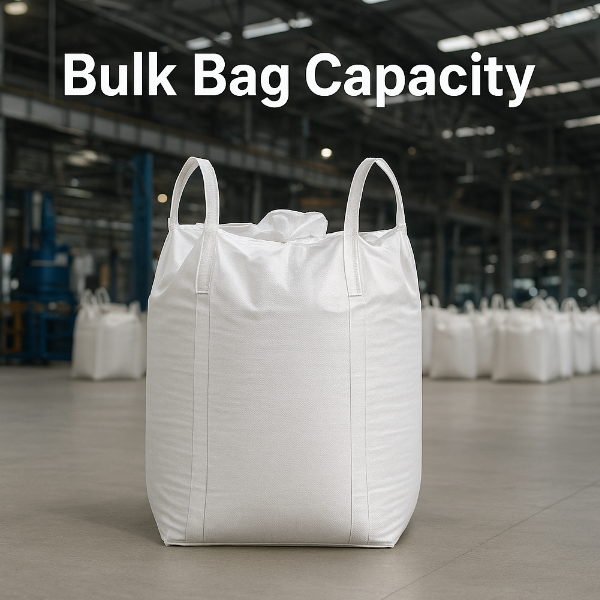
Let’s break down the details.
1. The Standard Answer: 1 Cubic Meter
The most common and widely recognized size for a bulk bag is 1 cubic meter (1 m³). This is the standard “one-ton bag” you’ll find for many materials like sand, gravel, and soil.
- Typical Dimensions for a 1 m³ Bag: Around 90 cm x 90 cm x 90 cm (a cube). (Calculated as: 0.9m x 0.9m x 1.1m ~= 0.89 m³, which is often rounded and sold as 1 m³).
2. Why the Capacity Varies: Key Factors
Several factors determine the actual volume of a bulk bag:
- Dimensions (Length x Width x Height): This is the most important factor. Bags come in different sizes.
- Shape:
- Standard U-Panel Bags: Have a more rigid, cubic shape when filled.
- Circular / Four-Panel Bags: Have a cylindrical shape when filled, which holds more volume for the same fabric width.
- Safe Working Load (SWL): Bags designed for heavier materials (e.g., gravel) might have thicker fabric and smaller dimensions to handle the weight, resulting in a lower volume. Bags for lighter materials (e.g., bark mulch) can be much larger in volume.
- Lifting Loops: The design of the loops (single use vs. 4-loop) can affect how the bag settles and its final filled dimensions.
- The “Fill Factor”: You should never fill a bulk bag to its absolute maximum physical capacity. A “fill factor” of 80-90% is often applied for safety and stability during lifting and transport.
3. How to Calculate the Cubic Meters Yourself
You can easily calculate the volume if you know the bag’s internal dimensions.
Formula: Length (m) x Width (m) x Height (m) = Volume (m³)
Examples:
- Bag A: 80cm x 80cm x 90cm
- Calculation: 0.8m x 0.8m x 0.9m = 0.576 m³
- Bag B: 90cm x 90cm x 110cm
- Calculation: 0.9m x 0.9m x 1.1m = 0.891 m³ (Often sold as a 0.9 m³ or 1 m³ bag)
- Bag C (Circular): Diameter 95cm, Height 120cm
- Formula for a cylinder: π x r² x h (where r = radius)
- Radius = Diameter / 2 = 0.95m / 2 = 0.475m
- Calculation: 3.14 x (0.475)² x 1.2 = 3.14 x 0.2256 x 1.2 ≈ 0.85 m³
4. Capacity Chart for Common Materials
The cubic meter capacity tells you the space the bag takes up. The weight it can hold depends entirely on the density of the material inside. A 1 m³ bag will be weight-full with a dense material like sand long before it is volume-full with a light material like peat moss.
| Material | Approximate Density | Volume of a 1000 kg (1-ton) Bag |
|---|---|---|
| Water | 1000 kg/m³ | 1.0 m³ |
| Sand (Dry) | 1600 kg/m³ | ~0.65 m³ |
| Gravel | 1500 kg/m³ | ~0.67 m³ |
| Potting Soil | 400 kg/m³ | ~2.5 m³ |
| Bark Mulch | 300 kg/m³ | ~3.3 m³ |
| Salt | 1200 kg/m³ | ~0.83 m³ |
Important Note: You must always check the Safe Working Load (SWL) of the bag itself. Never exceed this weight limit, even if the bag is not yet full.
Summary & Key Takeaway
- There is no single universal volume for a bulk bag.
- The most common size is 1 cubic meter (m³).
- The practical range is typically 0.7 m³ to 1.2 m³.
- Always check the specifications from your supplier for the exact dimensions and Safe Working Load (SWL).
- Calculate the volume yourself using the length, width, and height if the specifications are not clear.
When searching or purchasing, it’s best to look for the specific volume (e.g., “0.9 cubic meter bulk bag”) to ensure you get the right size for your needs.