
📑 Table of Contents
📖 Introduction
If you’ve ever used standard bulk bags (FIBCs), you may have noticed they tend to bulge into a round or barrel shape when filled. This not only reduces stacking stability but also wastes valuable warehouse and container space.
Enter the baffle bag — also known as a baffle FIBC or baffle bulk bag.
In this guide, you’ll learn exactly what a baffle bag is, how its internal baffles work, the key benefits over standard bags, and the most common real‑world applications. This information is especially useful for manufacturers, logistics managers, and procurement professionals in North America and Europe.
1. Baffle Bag Meaning (Definition)
A baffle bag is a type of Flexible Intermediate Bulk Container (FIBC) that has internal fabric panels (baffles) sewn into its four corners. These baffles are attached to both the top and bottom of the bag.
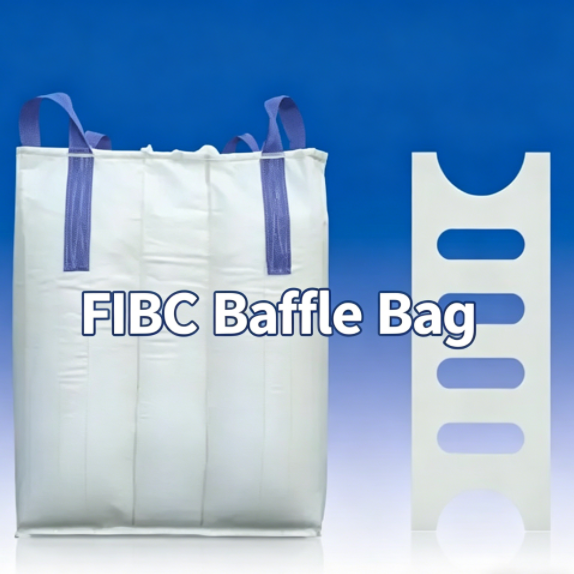
When the bag is filled, the baffles restrict the fabric from bulging outward, forcing the bag to maintain a square or rectangular shape — even under heavy load.
In simple terms: A baffle bag is a bulk bag designed to stay square, not round.
Baffle Bag vs. Standard Bulk Bag
| Feature | Standard Bulk Bag | Baffle Bag |
|---|---|---|
| Shape after filling | Rounded / barrel | Square / cuboid |
| Stacking ability | Limited (1–2 layers) | High (3–4+ layers) |
| Discharge efficiency | Moderate | High (less material hang‑up) |
| Pallet / container space utilization | Lower | Maximized |
| Cost | Lower | Slightly higher (+5‑15%) |
2. How Do Internal Baffles Work?
The baffles are typically made of the same woven polypropylene fabric as the bag body. They run vertically inside the four corners, connecting the top and bottom lifting loops areas.
When material is poured in, the fill pressure pushes outward. However, the baffles act as tension straps — they prevent the bag from expanding into a circle. Instead, the bag’s sides remain flat and its corners well‑defined.
Visual analogy: Imagine a cardboard box with internal diagonal supports. Without the supports, the box bulges. With them, it keeps its shape. Baffles do the same for FIBCs.
3. Key Benefits of Using Baffle Bags
- ✅ Prevents Bulging – Maintains Square Shape: The most obvious benefit. A square bag is stable, stackable, and space‑efficient.
- ✅ Improves Stacking Stability and Safety: Because the bag keeps its cuboid shape, each bag sits flush on the one below. Baffle bags are commonly stacked 3 to 4 high in warehouses or shipping containers.
- ✅ Maximizes Storage & Transport Efficiency: In a 20‑ft shipping container you can fit about 10–20% more baffle bags than standard round‑bulge bags. Pallet patterns are cleaner.
- ✅ Enhances Discharge & Reduces Residue: Flat side walls prevent “bridging” or “ratholing”. Material flows uniformly, leaving less residue.
- ✅ Compatible with Liners: For moisture‑sensitive or hazardous materials, baffle bags work seamlessly with inner liners (PE, aluminum foil). The baffles hold the liner in place.
- ✅ Better for Automated Filling Lines: High‑speed filling systems perform better when the bag opens into a consistent square shape.
4. Common Applications & Use Cases
Baffle bags are not for every product. They shine in specific scenarios where shape retention, stacking, and discharge are critical.
4.1 Powders & Fine Materials
Examples: Calcium carbonate, talc, titanium dioxide, cement, lime, fly ash, starch, flour, milk powder.
Why baffle bags? Powders often cause bulging. A square shape prevents rolling or shifting during stacking.
4.2 High‑Density Granules
Examples: Plastic pellets (PVC, PE, PP), rubber granules, quartz sand, feldspar.
Why baffle bags? Heavy materials increase lateral pressure. Baffles counteract that pressure, keeping the bag stable.
4.3 Export & Container Shipping
Scenario: Loading 20‑24 metric tons into a 40‑ft high‑cube container.
Why baffle bags? Every inch counts. Square bags allow tight, interlocking rows without wasted gaps.
4.4 Multi‑Layer Warehousing
Scenario: Rack storage or floor stacking above 2 layers.
Why baffle bags? Standard bags often become unsafe after the second layer. Baffle bags remain stackable up to 4 or even 5 layers (depending on SWL and safety factor).
4.5 Hygroscopic or Sensitive Products (with Liner)
Examples: Dried fruit, specialty chemicals, pharmaceutical intermediates.
Why baffle bags? The liner stays fully expanded, preventing creases where moisture could accumulate.
4.6 Reusable / Returnable Packaging
Scenario: Closed‑loop supply chains (automotive, industrial compounds).
Why baffle bags? Baffle bags retain their shape through multiple filling/unfolding cycles, unlike standard bags that deform permanently.
5. When NOT to Use a Baffle Bag
Baffle bags are not universal. Avoid them when:
- Material contains sharp or irregular objects (recycled metal scrap, broken glass, rocks). Sharp edges can cut or snag the baffles.
- Very low fill density / fluffy materials (e.g., expanded perlite, wood shavings). The bulging pressure is too low for baffles to be effective.
- You need extreme flexibility in filling spout types – some manual filling funnels may be obstructed by baffles.
- Budget is extremely tight – standard bags are cheaper, though baffle bags often pay back in space savings.
6. How to Choose the Right Baffle Bag
When selecting a baffle bag, consider the following:
| Factor | Recommendation |
|---|---|
| Safe Working Load (SWL) | Usually 500–2000 kg. Match to your product weight. |
| Baffle type | Full‑height baffles (standard) or partial baffles (for semi‑bulge control). |
| Top style | Spout top, open top with skirt, or duffle top. |
| Bottom style | Flat bottom, spout bottom, or discharge spout with tie. |
| Liner requirement | Unlined, PE liner, or foil liner for moisture/oxygen barrier. |
| Lifting loops | 4‑loop or cross‑corner loops (for standard forklift or crane). |
| Safety factor | 5:1 or 6:1 (higher for hazardous goods). |
7. Frequently Asked Questions (FAQ)
8. Conclusion: Is a Baffle Bag Right for You?
If you need stable, square‑shaped bulk bags that stack high, save space, and discharge cleanly — especially for powders, granules, or export shipping — then a baffle bag is likely the best choice.
While the upfront cost is slightly higher, the return on investment comes through:
- More product per shipping container
- Safer warehouse stacking
- Less product residue (reduced waste)
- Fewer damaged bags during transport
For standard, low‑stacking, or non‑critical applications, a regular bulk bag will still work fine. But for professional logistics and high‑performance packaging, baffle bags are the industry standard in North America and Europe.
9. Additional Resources
- FIBC Testing Standards (EN ISO 21898, BS EN 27721)
- Guide to UN‑Certified Baffle Bags for Hazardous Goods
- A Deep Dive into the Q Bag
© FIBC Bag Factory – Professional guide to baffle bags. Improve your bulk packaging efficiency.